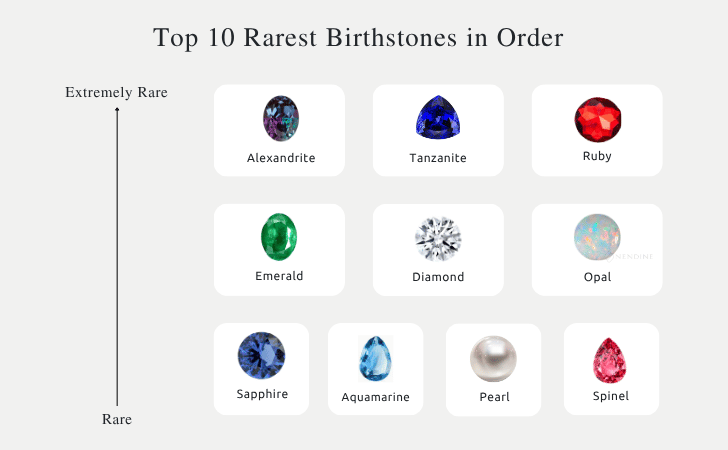
Some birthstones are commonly found in mines across multiple continents, but there are others that are very hard to find—they are only available in a few locations and in small quantities.
In this article, we will give a list of the rarest birthstones in order of their scarcity, from the rarest to the least rare.

What is the Rarest Birthstone?
Alexandrite (June’s birthstone) is the rarest birthstone to find. This is mainly because of its remarkable color-changing effect and its extremely limited supply. During the day, it appears green or bluish-green, while under warmer lighting, it shifts to reddish or purplish tones.
Rarest Birthstones List in Order Comparison Table
Below is a tabular list of the rarest birthstones in order of their month, rarity level, and the different reasons they are rare.
| Rank | Birthstone | Month | Rarity Level | Why Rare |
| 1 | Alexandrite | June | ⭐⭐⭐⭐⭐ | Rare color-change and limited sources |
| 2 | Tanzanite | December | ⭐⭐⭐⭐⭐ | Single-source gemstone with finite supply |
| 3 | Ruby | July | ⭐⭐⭐⭐☆ | Top-quality stones are extremely scarce |
| 4 | Emerald | May | ⭐⭐⭐⭐☆ | Clean, vivid stones are hard to find |
| 5 | Diamond | April | ⭐⭐⭐☆☆ | Abundant supply, rare only in top grades |
| 6 | Opal | October | ⭐⭐⭐☆☆ | Rare varieties have limited sources |
| 7 | Sapphire | September | ⭐⭐⭐☆☆ | Premium origins are limited |
| 8 | Aquamarine | March | ⭐⭐☆☆☆ | Deep blue color is less common |
| 9 | Pearl | June | ⭐⭐☆☆☆ | Natural pearls are extremely rare |
| 10 | Spinel | August | ⭐⭐☆☆☆ | Fine-quality stones are limited |
If you want to explore all birthstones by month, including both classic and updated gemstone associations, you can also check our modern and traditional birthstone chart.
Top 10 Rarest Birthstones in 2026 (From Rarest to Most Common)
There is no universally accepted ranking of birthstone rarity. This comparison considers mining limitations, collectors’ demand, and how difficult it is to source high-quality birthstones in today’s market.
1. Alexandrite (June) – The Rarest Birthstone
It ranks as the rarest birthstone because of its renowned color-changing property and highly limited sources. This optical feature results from the presence of chromium in its composition. The stone was originally discovered in Russia’s Ural Mountains, but quality deposits are now extremely scarce. Small quantities also come from Sri Lanka and Brazil.
2. Tanzanite (December)
When asked: which birthstone is the rarest? Tanzanite always comes to mind because it is mined in only one location on Earth – the Merelani Hills of Tanzania. It’s a form of pleochroism where the stone displays three different colors from different viewing angles. Tanzanite’s one geographical source makes people fear that existing deposits may soon become depleted, which has further increased its rarity.
3. Ruby (July)
Ruby birthstones, especially the ones that have the “pigeon blood” red color are very rare. While commercial-grade rubies are relatively accessible, natural untreated rubies with high clarity are difficult to get and are sold for premium prices. The finest rubies traditionally come from Myanmar, Mozambique, and Thailand.
4. Emerald (May)
Emerald stones are valued for their rich green color, but they often come with inclusions. Those with vivid green color and fewer visible inclusions are highly rare. You can however see the world’s most famous emeralds in Columbia, while Zambia and Brazil are also major mining regions.
5. Diamond (April)
When considering what are the rarest birthstones based on how expensive they are? Diamond tops the list of the most expensive birthstones in order 2026. While the cultured ones are largely sold commercially, natural diamonds with exceptional clarity, color, and cut quality are genuinely hard to find. The rarity increases for flawless and fancy colored diamonds. Major regions to find them are Botswana, Russia, Canada, and South Africa.
6. Opal (October)
The optimal value behind opal comes from its unique play-of-color effect, where flashes of multiple colors appear across the surface as light moves. Top-quality opals with strong brightness, vivid color patterns, and stability are extremely difficult to find. However, a small amount of quality opals can be sourced from Australia, while Ethiopia has recently become another major region.
7. Sapphire (September)
While you may see sapphires available in many qualities, untreated sapphires with bold saturation and excellent clarity are rare. Kashmir sapphire, for example, which is highly valued for its alluring velvety blue appearance, is hard to find in this modern age. Today, important sapphire sources include Sri Lanka, Madagascar, and Myanmar.
8. Aquamarine (March)
Aquamarine may be somewhat common in today’s market, but the ones with a highly saturated blue color are very rare. The premium ones have deep, vivid blue colors, making them have stronger demand among collectors and jewelers. They are mostly sourced in Brazil, though small deposits are found in Pakistan, Madagascar, and Nigeria.
9. Pearl (June)
Natural pearls are rare because they form organically inside mollusks without human intervention. There are some that are rarer — those that have strong luster, smooth surfaces, and balanced shapes. Major regions to get natural pearls are Japan, China, Australia, and French Polynesia.
10. Spinel (August)
Spinel has gained traction in recent years because of its vibrant colors and durability. The rarest colors are the fine red and cobalt-blue spinels. Oftentimes, this birthstone is mistaken for ruby because they look alike. Major sources for spinel are Myanmar, Sri Lanka, Tanzania, and Vietnam.

Which Month Has the Rarest Birthstone?
June has the rarest birthstone. The month has 2 popular birthstones: Alexandrite and Pearl.
Alexandrite is the most scarce birthstone due to its limited supply and dramatic color-changing feature. Pearl (especially natural pearl) is also hard to find but not the rarest birthstone in order.
If you want to explore the symbolic meanings behind different gemstone colors by month, read our guide on Birthstone Colors and Meanings by Month.
What is the 3 Rarest Birthstone?
The 3 rarest birthstones are Alexandrite, Tanzanite, and Ruby.
Alexandrite ranks first because of its unique color-changing effect and limited supply. Tanzanite follows due to its single-source origin in Tanzania. Ruby (particularly untreated ones with high-quality “pigeon blood” color) comes next because of its bold tone and high clarity.
What is the Second Rarest Birthstone?
Tanzanite is the second rarest birthstone. Its scarcity comes primarily from its single mining region. While other birthstones have multiple sources, Tanzanite can only be obtained from one place—the Merelani Hills of Tanzania. This restricted supply, combined with strong demand for vivid blue-violet stones increases its rarity and long-term collectible value.
What is the Least Rarest Birthstone?
Based on this ranking of the top 10 rarest birthstones, Spinel is the least rare stone. While there are fine Spinels that are very valuable and scarce to some degree, they are still more available compared to birthstones like Alexandrite or Tanzanite.
What is the Rarest Birthstone in the World?
Alexandrite is considered the rarest birthstone in the world because of its standout optical properties and limited natural availability. High-quality stones that are capable of shifting from one color to another, such as Alexandrite’s green-to-red color are extremely uncommon.
Conclusion
When evaluating what is the rarest birthstone, you need to note that the rarity is not based only on popularity. You have to consider factors like geographical limitations, mining difficulty, stone quality, and natural optical effects. In consideration of all these, we’ve collated a list of the top 10 rarest birthstones in order, with Alexandrite taking the lead.
For jewelry brands and retailers looking to create unique birthstone jewelry collections, working with an experienced custom jewelry manufacturer can help bring rare gemstone designs and personalized concepts to life.