Pearls come in different types—some more valuable than others—thereby creating confusion about their worth. As of now, pearls can cost as little as $20 to as much as $10,000+.
In this guide, we will answer the pressing question: how much are pearls worth? We will also break down real 2026 market prices and explain what determines a pearl’s value.

How Much are Pearls Worth?
If you’re wondering how much are real pearls worth, the answer can vary widely depending on the type, size, and overall quality. In today’s market, most real pearls range from $25 to $350+ per pearl, with premium pieces reaching much higher.
Their worth varies significantly depending on the types of pearls:
- South Sea Pearls: $220 – $350 per pearl
- Tahitian Pearls: $220 – $350 per pearl
- Akoya Pearls: $80 – $85 per pearl
- Freshwater Pearls: $25 – $35 per pearl
In general, freshwater pearls are the most affordable, while South Sea and Tahitian pearls are more valuable due to their larger sizes, rarity, and distinctive appearance.
Pearl Price Chart by Type 2026 (Real Market Data)
The following prices are estimated based on typical single pearl prices (mid-grade quality). These price ranges are based on our 10+ years of experience in custom jewelry manufacturing and are cross-checked with real data from our long-term pearl supply chain partners.
| Pearl Type | Single Pearl Price (Mid-Quality) | Estimated 16-inch Strand Price | Typical Size |
| South Sea Pearls | $220 – $350 | $3,500 – $12,000+ | 10–11mm |
| Tahitian Pearls | $220 – $350 | $3,500 – $12,000+ | 10–11mm |
| Akoya Pearls | $80 – $85 | $700 – $5,000 | 5–6mm |
| Freshwater Pearls | $25 – $35 | $80 – $2,500 | 5–6mm |
(Note: Actual pricing may vary depending on matching, luster, surface quality, and craftsmanship. Medium-quality pearls generally refer to pearls that are near-round to almost perfectly round, medium to high luster, and minor to very slight surface imperfections.)
Pearl Price Comparison by Pearl Type
Generally speaking, saltwater pearls (South Sea, Tahitian, and Akoya) cost more than freshwater pearls. Below is the typical price range for each pearl type and their standout characteristics.
South Sea Pearls
South Sea pearls are the most valuable because of their large size and thick nacre. Their satin-like luster lasts longer than most pearls, making them a top luxury choice. They represent the highest tier in both size and overall market value.
Typical Price Range:
- Single Pearl: $220 – $350 (10-11 mm, mid quality)
- Medium-quality: $3,500 – $12,000+ (16-inch per strand)

Tahitian Pearls
Tahitian pearls stand out for their natural dark colors, including black, green, and peacock tones. Their value is driven by color rarity and uniqueness, making each pearl distinct and often more collectible than standard white pearls.
Typical Price Range:
- Single Pearl: $220 – $350 (10-11 mm, mid quality)
- Medium-quality: $3,500 – $12,000+ (16-inch per strand)

Akoya Pearls
Akoya pearls are valued for their exceptional luster and near-perfect round shapes. They are the perfect choice for buyers who prioritize perfect round shape, high luster, and classic elegance over size.
Typical Price Range:
- Single Pearl: $80 – $85 (5-6 mm, mid quality)
- Medium-quality: $700 – $5,000 (16-inch per strand)

Freshwater Pearls
Freshwater pearls are the most affordable because of their accessibility and large supply. They are available in a wide range of shapes, from low-cost rice pearls to higher-value baroque and near-round options. These pearls are the best choice for budget-conscious buyers. High-end freshwater pearls (like Edison pearls) can achieve luster and surface quality comparable to some seawater pearls.
Typical Price Range:
- Single Pearl: $25 – $35 (10-11 mm, mid quality)
- Medium-quality: $80 – $2,500 (16-inch per strand)
What Affects the Value of Pearl? 6 Main Factors
Just like the 4Cs of diamond valuation stipulated by the Gemological Institute of America (GIA), there are 6 main factors for the pearl grading system. They include:

1. Pearl Size
The larger the pearl is, the more valuable it is. But you have to consider the other 5 factors before knowing the pearl’s actual worth.
Typical Size That Each Type Grows into:
- South Sea Pearls: Typical size is between 8 mm and 13 mm. Larger sizes are available in 13 mm to 15 mm
- Tahitian Pearls: Typical size is between 8 mm and 13 mm. Larger sizes are available in 13 mm to 15 mm
- Akoya Pearls: Typical size is within 5 mm to 8.5 mm. Larger sizes are available in 8.5 mm to 10 mm
- Freshwater Pearls: Typical size is between 5 mm and 8.5 mm. Larger sizes are available in 8.5 mm to 14 mm
Example:
- A 5-6mm freshwater pearl strand (16 inches) might cost $80 – $2,500.
- A 7-8mm freshwater pearl strand (16 inches) of similar quality might cost $300 – $4,000.
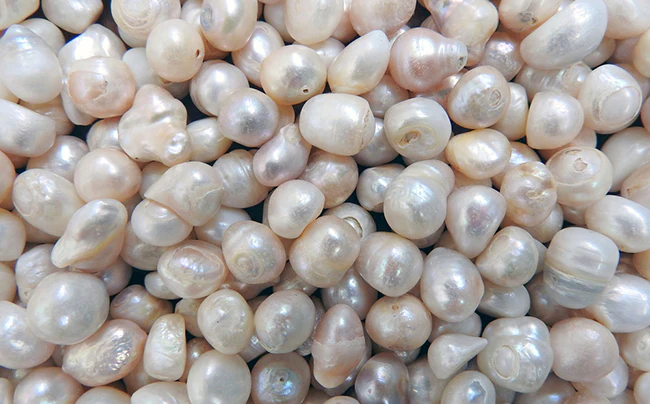
2. Pearl Shape
The best shape a pearl can have is perfectly round. It is more valuable that way. But these kinds of pearls are very hard to find. The typical pearl shape you can find in the market is near-round.
Pearl Price by Shape:
- Round: Rarest and the most valuable; about 20%-50% more expensive than near-round
- Near-round: Slightly less expensive; visually similar to round
- Oval: Moderately priced with elegant elongation
- Button: Flattened shape, often used in earrings
- Drop: Teardrop shape, often used for pendants
- Baroque: Irregular shape, unique, and artistic; the cheapest
| Shape | Rarity | Price Point |
| Round | Rarest | $$$$$ |
| Near-round | Moderate | $$$$ |
| Oval/button/drop | Common | $$ |
| Baroque | Widely available | $ |
3. Pearl Color
The color uniqueness and rarity of pearls influences their desirability and price. Vibrant overtones often typically command higher prices. South Sea and Tahitian have the most expensive pearl color—bodycolor, overtone, and orient.
Typical Pearl Color by Pearl Type:
- South Sea Pearls: Golden, silver, white
- Tahitian Pearls: Black, peacock, green
- Akoya Pearls: White, cream, silver
- Freshwater Pearls: White, pink, lavender
4. Pearl Luster
High-luster pearls have a mirror-like shine and command premium prices. In contrast, lower-luster pearls appear duller, more blurred, and are less expensive.
GIA divides pearls into 5 categories:
- Excellent: Bright, sharp reflections
- Very Good: Bright and near sharp reflections
- Good: Bright, but not sharp reflections
- Fair: Weak, blurred reflections
- Poor: Dim, diffused reflections
5. Pearl Nacre Quality
Thicker nacre means better durability, luster, and value. Whereas, thin nacre pearls may have good initial shine but are prone to dullness and peeling over time.
Nacre Quality Classification:
- Acceptable: Nucleus not visible and no chalky appearance
- Nucleus Visible: Shows traces of bead nucleus through nacre
- Chalky Look: Obvious dull appearance
6. Pearl Surface Quality
As an organic gem, nearly all pearls have some form of imperfections on their surface. Those with completely clean surfaces are rare and more expensive.
Pearl Surface Grade:
- Clean: No visible blemishes; flawless appearance
- Lightly Spotted: Minor blemishes but barely noticeable
- Moderately Spotted: Visible spots; noticeable imperfections
- Heavily Spotted: Many blemishes; heavily flawed surface
How Much Does a Pearl Cost?
Still wondering how much does a real pearl cost? A single mid-quality pearl typically costs between $25 and $350+, depending on its type, size, and quality. Freshwater pearls are generally the most affordable (a single pearl $25 – $35), while South Sea pearls are the most expensive, with a single pearl over $220 – $350.
Larger pearls, better luster, and cleaner surfaces can increase the price significantly, especially for rarer types like South Sea pearls.
Typical Single Pearl Price
- South Sea Pearls: $220 – $350 per pearl (10-11mm, mid-quality)
- Tahitian Pearls: $220 – $350 per pearl (10-11mm, mid-quality)
- Akoya Pearls: $80 – $85 per pearl (5-6mm, average quality)
- Freshwater Pearls: $25 – $35 per pearl (5-6mm, average quality)

Real-life Example: From $100 to $5,000+, What Your Budget Can Get?
Pearl pricing isn’t just about type—it’s about what your budget can realistically buy. From affordable freshwater pearls to luxury South Sea strands, each price tier reflects upgrades in luster, surface quality, strict quality control, and matching.
Here’s a practical breakdown of what to expect at every budget level:
$100 – $300
- 5–6mm freshwater pearl strands (lower to mid quality)
- Rice pearl necklaces or bracelets
- Baroque pearl earrings or pendants
- Slightly irregular shapes, medium luster
Best for: Entry-level buyers and fashion jewelry
$500 – $1,500
- Higher-quality freshwater pearl strands (5–7mm)
- Entry-level Akoya pearl pieces (studs, pendants, small strands)
- Small Tahitian pearl jewelry (single pearl pendants or earrings)
- Better luster and more consistent shape
Best for: Everyday fine jewelry with better durability and appearance
$2000 – $5,000
- High-quality Akoya pearl strands (5–7mm, strong luster)
- Premium freshwater strands (larger sizes or near-round quality)
- Tahitian pearl strands (smaller sizes or mid-quality matching)
- Entry-level South Sea pearl jewelry (pendants or earrings)
Key upgrade: Noticeably better matching, luster, and surface quality
Above $5000
- South Sea pearl necklaces (10–11mm and above)
- High-quality Tahitian pearl strands with strong overtones
- Perfectly matched Akoya strands (top grades like Hanadama)
- Larger pearl sizes with excellent luster and clean surfaces
Positioning: Luxury and investment-level jewelry
As your budget increases, the upgrade is not just size — it’s luster, matching, and surface quality that truly define value.
Key Takeaways
There is no generic answer for how much are pearls worth. It depends on the type, size, shape, color, luster, nacre quality, and surface quality. If you are not sure what your budget can get you, consult a custom jewelry manufacturer to explore personalized options that meet your needs and budget.
FAQs
Yes, pearls are highly valuable. Even affordable freshwater pearls have resale and aesthetic value, while rare South Sea and Tahitian pearls can be worth thousands of dollars.
Pearls can be both affordable and expensive, depending on the pearl type, quality, and rarity. Freshwater pearls are the most affordable, costing under $100. The South Sea is the most expensive, costing tens of thousands of dollars.
They are expensive because of their formation process, cultivation time, and rarity. Factors like their size, luster, nacre thickness, and surface quality also significantly influence their price.
South Sea pearls are the most expensive because of their large size, thick nacre, and rarity. Their luxurious appearance and durability make them the highest-valued pearl in the market.
Real pearl necklace prices vary significantly depending on the type of pearl, with 16-inch strand prices typically ranging from $80 to over $12,000+.
– Freshwater pearl necklaces: $80 – $2,500
– Akoya pearl necklaces: $700 – $5,000
– Tahitian pearl necklaces: $3,500 – $12,000+
– South Sea pearl necklaces: $3,500 – $12,000+
Yes. Baroque pearls are generally more affordable, but high-quality South Sea or Tahitian baroque pearls with strong luster and unique shapes can be highly valuable in designer jewelry.